Not the first time, won’t be the last either
A satyagrah when standing in solidarity with a cause or a people appears to a third person as a voluntary act. But as one absorbs the spirit of resistance and solidarity, it becomes an urge, a pull, a drive to act. Given that we are typically not the ones in the eye of the storm, we apply reason, strategize, coordinate, organize, mobilize and try to maximize the impact of the act of resistance.
It was very appropriate that in the morning I attended a panel discussion on Gandhi’s views on dissent and sedition in the first half of the day. And in the second half a talk by Tanveer Ajsee on the historical roots of Kashmir art today. The languages of dissent and expression used by Kashmiris – in their attire and presentation, on canvas, paper or pavments, in their music, dance and celebrations of weddings or commemorating their martyrs.
My satyagrah yesterday was in protest of the govt of India’s communication blockade in Kashmir. If we are to believe the govt of India, 8 million+ people have been subjected to a lockdown so that a few hundred people are kept from communicating between themselves and the rest of the world. For 61 days. Where is the sense of proportion? Is there any concern to human life and livelihood in such actions by the state? In reality, the blockade is yet another step in the further alienization and brutalization of a community. A community that has seen, and survived through, at least 175 years of repression, deceit and exploitation by various states – British, Dogra, and Indian.
There is an attempt to re-weave the Indian social fabric to distract every one from the large scale exploitations of resources and energies. To establish a supremacy, to reiterate and stamp a chauvinistic identity among a majority. A majority that is being told over and over again and is starting to believe that it is under threat. History is replete with cases of the rich and powerful consolidating their hold over the state using this fear. And of communities singled out and oppressed to assuage the collective conscience of society.
The Govt of India, with its actions over the past 39 years or so has ensured that whatever bridges were built are chopped down and brunt to the ground. Again and again. Keeping an active military in a region has never brought peace to that land. The UK, US, Russia, and every hegemonic power center has experienced this. War and occupation brings wealth and excess to the oppressors. And the blood soaked money and power is what we are getting out of Kashmir.
As frequent as these oppressions are the acts of resistance. The living up to ideals, the giving up of livelihoods, freedoms and even lives for certain truths that one holds dear. The defiance of those who don’t just believe that love and peace should prevail, but are ready to stand up and say not in my name; not again.
We can amend laws, we can change the rules. But we cannot legislate affection for a state or fraternity and brotherhood with the rest of the country. It has to be earned.
Share this:

Make an umbrella or build a boat?
The monsoon rains in most parts of India arrived late and in many places has been pouring so much that it has led to large scale flooding – initially it was parts of Karnataka and Maharashtra, now in UP and in Bihar.
But more than the rains unleashed by the late monsoon this year, civil society in the country has been bearing one assault after another from none other than the ruling establishment for a few years now. The Govt. of India has decided that its energy is best used to curtail and restrict the activities of organizations, individuals and communities however legal and/or humanitarian they might have been; that there should be those with full rights and those who shall remain at the mercy of the mob; that there is no need to heed to laws, constitutional norms, or legal precedent; that any right or freedom is subject to the person’s perceived patriotism (perceived because, a mob does not ask questions before unleashing violence).
The Govt of India laid siege on Kashmir, through a revised List of Business on the last day of the parliamentary session, de-operationalized Article 370 and 35A, converted a state with a special status in the Indian Constitution into two union territories, and all this without even a charade of consulting the people of that land. Sitting MPs, MLAs, former Chief Ministers, political leaders of all hues have been illegally detained for almost two months now. And the Supreme Court, in its supreme wisdom, has pushed aside Habeas Corpus petitions with a we don’t have the time to hear them ! An undeclared emergency has been imposed in Kashmir. People raising their voice in support of Kashmir in other parts of the country, barring a few exceptions, are threatened by ideologues while the police and the administration either look away or stand with those issuing the threats!
So as we celebrate the 150th birthday of MK Gandhi the apostle of peace  it is quite logical that we step forward to understand and embrace non violent protests in the form of a satyagraha. And given that it is now 2019, a cyber satyagraha is that much more appropriate.
Since the night of Aug 4th/5th communication for millions of people in the Kashmir valley has been cut off. 58 days Kashmiris have been cut off from the internet, from each other and the rest of the world. As part of the cyber-satyagraha, I shall be cutting myself off from the internet and all telephone (mobile and landline connections) from 10 AM to 10 PM on Oct 2nd 2019. I shall be joining others at different events in Bengaluru to express my dissent and to hear from those being oppressed by our govt. in our name. I shall also be writing about my experience after completing my satyagraha.
If you also feel what is happening in Kashmir is not correct, raise your voice !
बोल के लब आज़ाद है तेरे
Speak, for your lips are still free
ಮಾತಾಡು, ನಿನ್ನ ತುಟಿಗಳನ್ನಾರೂ ಸೆರೆ ಹಾಕಿಲ್ಲಾ
Share this:

Simple yet memorable lessons learned – how to break a locked air pocket
I’m in a remote part of rural Odisha, with green hills in all directions and amazing people who know so much about their ecosystem, their land, their traditions, their fellow community members and very likely themselves. The initiative that has been bringing me here every few months for the past 3 years is trying to even the balance as these communities interact more and more closely with markets and commerce oriented individuals and institutions. One part of that initiative is a rotary cold press oil mill and another is a set of machines to process millets such that their nutritional value is retained. This visit was planned to be a refresher course for local youth who have been trained to run these machines. But the rotary mill had a breakdown a week ago. With more than 40 sacks of mahua seeds waiting to be crushed, the primary objective was now to fix the rotary mill.
A rotary mill is essentially a mortar and pestle with the pestle held stationary while the mortar is driven by a motor. A gear box is used to achieve 20 rpm rotational speed of the mortar (from the motor’s 960/1440 rpm). The shaft of this gear box on which the mortar sits had broken and needed to be replaced. Even with a ratchet and winch, it took some effort to get the heavy mortar and pestle off – each of them weighs about 100 kgs. After being instructed about a couple of neat tricks, the broken shaft was exposed, available to be hauled out of the gear box.
The gear shaft sits on 2 bearings at either end with a coupling gear in between. The only points of contact of the shaft with the body are through these components. When rotated, the shaft was rotating without any problem – so all the components were fine, though the shaft itself had broken just above the gear box. The friend who made this rotary mill insisted that we just need to lift it and the shaft assembly would come off and out of the gear box. But the thing refused to budge. We tied a bamboo over it and tried to lift it, no movement. We hitched it onto the winch and the whole milling machine frame with motor started to come off the ground !
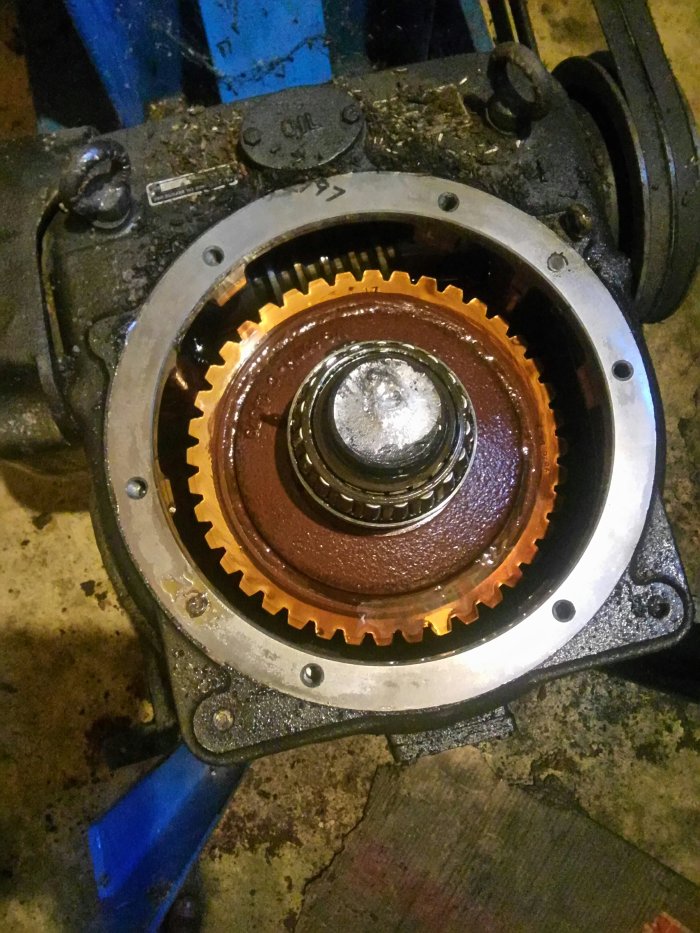
Our man on the phone insisted there isn’t anything else to it and that we should just take a time out and figure out how to break the locked air pocket that would have formed at the bottom bearing – the whole assembly is drowned in gear oil. I couldn’t see what else we could do, so we stepped back and took a breather, mulling over the fact that what we needed to do was lift the gear shaft assembly out of the gear box. We tired shaking the gear shaft, hammering it with a mallet, and yanking at it at different angles using some ropes tired around it – but the locked air pocket just did not break. Time to step back again.
The next thing I could think of was using was the principle of a lever. I picked up a 2′ long piece of bamboo, with the body of the gear box as fulcrum, I set the far end under the top bearing and the stated ‘levering’ away while rotating around the shaft and increasing the force as I went around. After a good 2 minutes of doing this and just as I was starting to go beyond my arm and use my body weight on the piece of bamboo, I hear the ‘pssschuk’ !! The locked air pocket was broken. And we were able to lift the gear assembly as if it was just sitting there!
Lessons learned:
- Locked air pockets can lift 300+ kgs.
- An off axis load that is a small fraction of the on axis load can break the locked air pocket.
- Step back and re strategize.
Ah, the joys of learning while doing !!
Share this:

Two statements that encapsulate why we should vote out the current BJP led NDA govt in New Delhi
The election season is heating up in Bengaluru faster than the summer heat. So speeches aplenty !
The actions of individuals and organizations form a much stronger component of my assessment of their personality and intent; their speeches and its semantics are a minor factor. Unfortunately – or may be fortunately, I am not sure – most people do not invest that much time and effort to analyse an individual or party and are easily influenced by words. So here’s a quick post on two statements from the ruling BJP that came out yesterday, April 11th, 2019. These encapsulate why we need to vote them out, not just vote for another party, but vote to defeat the ruling dispensation.
Quote #1:
Transparency cannot be applied without appreciating the problem faced by the legislature, which believed this to be the best way of solving it. The voter has the right to know what? They already know every single aspect about the candidate! Why are they concerned about the source of money of the political party?
There are many things the current dispensation has done to torpedo efforts towards accountability and transparency. Starting with moving important bills through the legislature as money bills, to trying to amend the RTI Act, to amendments to laws governing taxes and companies. The most insidious of the lot is the amendment to the Representation of The People Act and a bunch of other ones to allow for anonymous donations to political parties by ANYONE – including any corporate entity from ANY country – through instruments called Electoral Bonds. This thread of tweets from Meghnad has an amazing collection of resources to educate oneself about what these bonds are, how they came about and why every voter should be worried about it.
The AG defends this in open court hinting that any strictures would go against the legislature good intention ! Boss, your political masters DID NOT move it through the legislative process as it was intended in the constitution. The entire bunch of amendments setting up Electoral Bonds were passed as a Money Bill to side step the legislative process !
Quote #2:
We will ensure implementation of NRC in the entire country. We will remove every single infiltrator from the country, except Buddha, Hindus and Sikhs: Shri
@AmitShahOriginal Preamble to the Constitution of India

The BJP and its right wing affiliates (aka hindutva organizations) are bound by a common goal to shape India into a Hindu State. A deep rooted feeling they harbor and espouse – Pakistan chose to be an Islamic Republic, therefore India should be a Hindu Republic. But The leaders drafting the constitution of India chose it to be a DEMOCRATIC REPUBLIC. Consciously. And enshrined it in the preamble of the constitution. There is no way a country can stand for Justice, Liberty, Equality, and Fraternity while putting religious restrictions on those it provides refuge to. Anyone fleeing persecution deserves a fair and transparent hearing that is in keeping with the constitution. The BJP president has implicitly called for the very foundation of the country – its constitution to be overturned.
The BJP is looking to further its agenda of building a HINDU RASHTRA. We, the People, have to stand up and defend INDIA and its ethos.
A clarification – many of the current govt.’s policies that we oppose were brought in a slightly different form by earlier Congress led governments. We opposed it then. We oppose it now. We shall oppose such measures in the future.
Share this:

Its a journey and not a pursuit
There are multiple words that have been used – progressive, liberal, leftist, communist, etc. to describe those who have sought to pursue a purpose greater than the enrichment of themselves and their immediate family. I am not sure which of these describe me best. I do subscribe to the notions and ideas of cooperation and community ownership. Yet I do see how these quickly descend to nationalization and centralized decision making which invariably leads to alienation, disenfranchisement. And close at its heels, the bracketing and exclusion of people – of the other, of those people.
At a personal level, my effort to find a purpose for my existence and a use for my talents, started from (and continues to be driven by) a fairly fatalistic point of view – death is the only thing that is certain after one is born. It really does not matter in the broader scheme of things that a person was born today and died sometime after that. What does matter is what that person did when alive. Who remembers that person? who would rather forget that person?
These ideas had taken a deep enough root by the time I got to high school that I was sure I was not going to join the rat race. I am lucky to have been born, brought up and grow in a family that has allowed me to explore and shape my life the way I deemed fit. As neo-liberalism and communalization started competing for the body politic in India, I started identifying that the broader purpose of my life would be to work towards evening the keel and improving the access to resources that large sections of the population have been denied in almost all societies.
The fact that we know so little, we as in those outside of certain academic circles, about the lives of those who were not the kings or princes of years gone by belied the fact that those in power shall write the books of history. As this st

We must fix our eyes upon the catastrophes that we have behind us – and on the catastrophes of which we are the witnesses. For the atrocious has not happened, it is happening now, it is about to happen. We are entering an era of catastrophes: human, ecological and finally philosophical catastrophes. – Milo Rau, 24/11/2017.
arted sinking in, I came across a story of a small bird that tried to save its nest from a forest fire. As the other animals were trying to run and escape from the fire, they asked the bird, ‘what are you trying to do? you cannot put out the fire ! Fly away and live for another day’. The bird apparently replied, ‘I know I cannot put out the fire. But I shall try my best to save my chicks. If I fail, it will not be because I did not try.’ Thats a translated version; even though its been more than a decade since I heard this story and I have done numerous translations, I have not been able to capture the emotion of the last line, it is best said in Hindi – “जब इतिहास लिखा जाएगा, आग को भुजाने कि कोशिश करने वालों में मै गिनि जाऊँगी, आग को बढ़ने या उससे भागने वालो मे नहीं ” Yes, the importance given to historical record in this story is not something I took/take literally. The message that I took from it was that one needs to try, at least try, to fight for what one feels is worth saving before one follows the very natural response of self preservation.
These ideas have held me in good stead and helped me find more to spur me on – like the recent speech by Milo Rau. I see these providing me the tools to navigate further along in this journey.
It has been a hectic year with a lot of things happening – many unanticipated, some expected, and quite a few expected ones that did not happen. And that is what makes the journey beautiful, and the idea of a pursuit not worth pursuing ! 🙂
Its going to be just two posts in 2017. I hope, and have a feeling that, it will be better in 2018.
Share this:

GoI spins a ‘no, I really do love you!’ to Cooperative Banks as a relief to farmers
In the light of good monsoon and expectation of increased credit demand and in order to boost agricultural production, the farmers need to be supported through Cooperative Banks, which purvey credit at their doorstep, to enable them to scale up their agricultural operation.
The approval will ensure increased availability of short term crop loans to farmers through Cooperative banks at reduced rate of interest.
Share this:

On planning. executing. responding.
The idea of removing large value currency due to large scale counterfeiting is a good thing. I also agree that it is important to make it a surprise move. The logistics of the currency exchange in a country with a population and geography as India is a big challenge that almost no one has dared to undertake in the recent past. So irrespective of the merits of the exercise, kudos to the powers that are for taking on a challenge that most would have shied away from.
The first impact of any news among people living on the edge is almost always the same – panic. This is true not just in rural India, it is true even for the most urban communities of the most developed countries (think reactions to news of terrorist attacks, storms, hurricanes, etc.). And when the currency exchange bomb was dropped, the response was no different. People were scampering from pillar to post to convert the few 500 and 1000 rupee notes they have to the new/fresh currency. And they still are, even after a week.
Most day to day needs would cost around 100 to 200 rupees (thankfully!!). So what does one do with the new 2000 rupee notes when nobody is ready to part with the few smaller denomination currencies they have? So now they are scampering around for new currencies of the large denominations AND for smaller denomination older currencies.
A few simple questions about the implementation of the currency exchange policy. Not whether the currency exchange is warranted; Not Whether it will achieve its objectives. Just on Planning. Execution. Responding. :
- When you are rolling back 500 and 1000 rupee notes, would you not want to make sure that the smaller value new currency reaches the people first rather than the larger value one?
- When you are planning a roll back of the 500 and 1000 rupee notes, could a whole load of 100 rupee notes not have been printed and dispatched to currency exchange centers to service the obviously expected rush for legal currency to transact business with?
- What is the number of people estimated to land at a currency exchange center in an hour? Had sufficient currency reached these centers even a few days after the announcement? Were there sufficient people working at these centers to service the rush? Could some other personnel not have been pulled in to do assist in this work?
- How are you any different when the people who were already being crushed under the wheels of ‘development’ get crushed further ? (access and ability to use cash is what defines the poor !!)
- Could you not have chosen a better time than the planting period for the rabi crop? Ok, you missed it. But when you created exceptions for transport agencies (and later on added) utility companies and other amenities but EVEN in that list you do not include agri input vendors, who are your advisors? what news are you reading? Who does your heart blead for??
Taking on a challenge: brave
Not preparing adequately : unwise, foolhardy.
Not taking the plight of small traders, farmers, labourers : callous.
Responding to cries of the middle class : playing to the gallery.
Share this:

The nutrient cycle – closing the loop
A majority of even the conscious consumers, growing and eating food from sustainable farms are missing a crucial need for a food system to be sustainable – closing the loop of the nutrient cycle.
Lets consider that one grows food crops and livestock using all the sustainable practices, without using chemical inputs and all the while increasing natural resource replenishment. But at the end of the day, a good proportion of the output from the farm is consumed by humans, either living in/near the farm and many a time in a city or town somewhere. What happens to all the nutrients that moved out of the farm in the form of grains, fruits, vegetables, meat, etc?
In nature we see that nothing is a waste – one species’ refuse is another’s food. We digest and assimilate a small proportion of what we eat. Once it has served its purpose, a good proportion of what we consume is sent out of the body – mostly as stool, urine and sweat. What happens to all this “other species’ food”? We flush it down the drain, through a sewage system where it is concentrated all the while becoming a pollutant and then set up sewage treatment plants (that do not work most of the time) and end up polluting our rivers, lakes and seas.
What is the solution? Its a very simple age old practice. It saves precious water. It creates pure and clean compost. And returns the nutrients as food to plants and micro organisms in the soil. It is what is simply referred to as Dry composting toilets.
The Palar Center for Learning (aka Pathashaala) of the Krishnamurti Foundation of India about 75 kms south of Chennai has deployed this simple technology. They started as a black water free campus back in 2010. Over the years they have championed this cause so much that students, staff and visitors see this initiative as an essential part of the campus identity.
When I was introduced to Pathashaala as a resource person to help develop their local outreach efforts and ground some of their in-campus agricultural activities I jumped at the offer. I looked forward to a process of bidirectional learning. In the few months that I have been associated with the amazing folks there, I have completely fallen in love with their ethos and dedication to sustainable living and food systems. Needless to say, the clincher being the dry composting toilets !
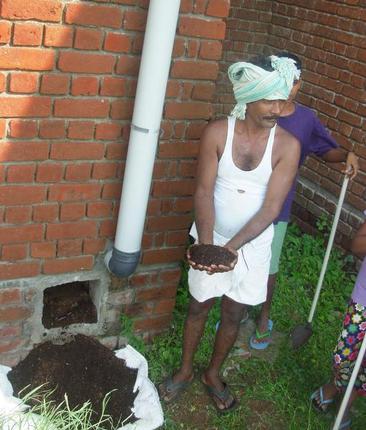
Compost harvested from a dry composting toilet at Pathashaala on Oct. 2nd 2016.
To get a better idea of the initiative do read this article sharing the experience of their recent compost harvest on the occasion of Gandhi Jayanti and this video from the previous year’s harvest. And to get a better idea of the technology itself, please see this small handout prepared by the one and only Gautama anna.
Agriculture does not end at the farm gate – eating is an agricultural activity; Food systems do not end at the dinner table. Returning nutrients to the soil is an integral part of a sustainable food system. And dry composting toilets is the simplest and most effective way to achieve this.
More on the concept, theory and some developments in design that have come about following my association with Pathashaala in the coming days & weeks.
Share this:

Simple quality tests for small millet rice
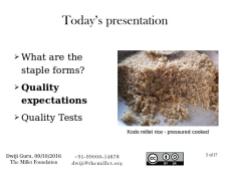
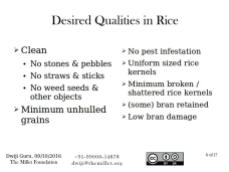
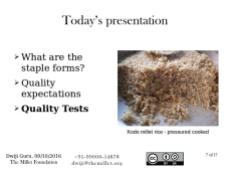
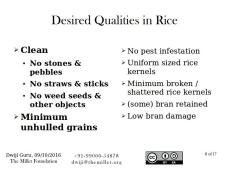
A couple of weeks ago, I started sharing some of my understandings of millets, their nutrition, economics, ecology and technology in 2 to 3 hr sessions. The first of these was on Simple quality tests for staple forms of millets. For convenience and brevity, I have split it into three different sets – one on millet rice, another on millets grits and rava and a third one on millet flours and mixes. Here’s the first one on millet rices …


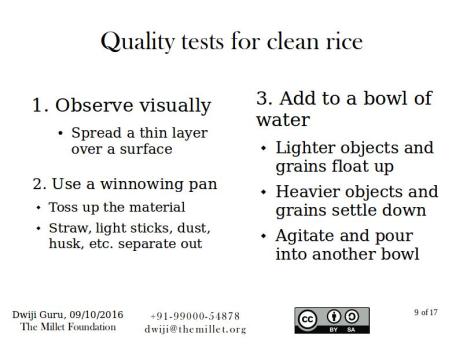
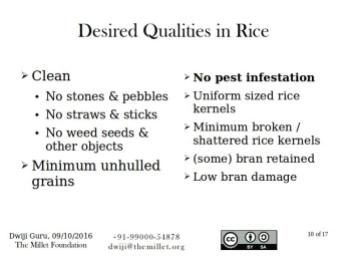


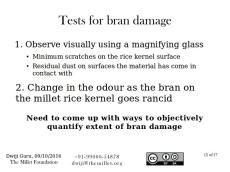


Share this:

Costing whole grain millet rice based diet …
When I talk about millets with those exploring better food options, a common concern expressed is the cost factor. “I am totally convinced from nutritional, environmental and social justice perspectives, but it is too costly. Not affordable.” It is a valid concern. Lets crunch the numbers on this …
Millet rices have a high satiety index, especially whole grain (unpolished) millet rices (wgmr). One feels more full on eating a smaller quantity of cooked wgmr than when eating the same quantity of polished paddy rice (ppr), or even whole grain (unpolished) paddy rice for that matter. But for now, lets look at how much it costs to serve a wgmr based meal as compared to a ppr based one.

Kodo millet rice, cooked using a pressure cooker.
In a meal, I eat about 300 to 400 gms of cooked wgmr. When I have a ppr based meal, I eat 400 to 600 gms before I feel full. Millets are thirsty grains and cooking wgmr takes more water than cooking ppr – 1:3 for wgmr as compared to 1:2 for ppr. So for a meal, I need at the most 400gms/4=100 gms of wgmr (dry, uncooked) and 600gms/3=200 gms of ppr (dry, uncooked). In BLR good quality wgmr will cost me about Rs. 100/kg and decent ppr would be about Rs.40/kg. So my cost per meal for wgmr is therefore Rs. 100*(100/1000)=Rs. 10 as compared to Rs. 40*(200/1000)=Rs. 8 for ppr.
This is just from sheer quantity and cost perspective. Factoring in the difference in nutrition that the two meals would provide, the cost of wgmr is already justified. But wait, there is yet another factor that needs to be taken into account.
Again, purely from the quantity perspective, almost everyone who has eaten wgmr based meals share this experience that even after 4 hours of the meal, they typically do not feel hungry for a snack. The same individuals after eating a ppr based meal would be seeking out something to snack on as they touch the 3 hours mark since their meal. This is primarily because of the high fibre (and small carbohydrate to fibre ratio) of wgmr. But from a purely financial perspective, just the ingredients cost of a snack would be anywhere from Rs. 3 to 5. Adding this to the above, when we have a wgmr based meals, I would incur an expense of Rs.10 before I get to the next meal, while on days I eat ppr based meals, I would incur an expense of Rs. 11 before I get to the next meal.
Q.E.D.
Please see some tips on cooking wgmr here to improve the experience of cooking and eating wgmr based dishes. And just search for ‘millets buy the-place-where-you-live’ online and you will find a whole list of online and real world stores where you can buy millets. Do call and check with them if the millet rices they sell are the whole grain (unpolished) kind before you decide to make the purchase.
Whole grain (unpolished) millet rices are not just good for our health, they are good for our pocket books too !!


 Dwiddly